Following the release of Mellifera 13 last week, some users reported problems getting the platform working correctly. They couldn’t browse a case’s tasks. TheHive Chefs reproduced the bug and corrected swiftly in Mellifera 13.1 (TheHive 2.13.1), which is now available. Please note that the identified bug happens only when you haven’t upgraded TheHive from an earlier version.
Is ES 2.x still supported?
Mellifera 13 introduced the support of Elasticsearch 5.x and has been thoroughly tested with version 5.5 (5.6 should be probably work just fine). Given the numerous changes between ES 2.x and ES 5.x, we do not support both versions. Hence, and starting from Mellifera 13, only ES 5.x is supported.
Download & Get Down to Work
If you have an existing installation of TheHive, please follow the migration guide. This is paramount to ensure a good transition from earlier versions. You have been warned.
If you are performing a fresh installation, read the installation guide corresponding to your needs and enjoy. Please note that you can install TheHive using an RPM or DEB package, use Docker, install it from a binary or build it from sources.
Support
Something does not work as expected? You have troubles installing or upgrading? No worries, please join our user forum, contact us on Gitter, or send us an email at support@thehive-project.org. We are here to help.
After the release wagon we unleashed upon the Internet tracks last week, we have updated the training VM to include Mellifera 13 (TheHive 2.13.0), Cortex 1.1.4, TheHive4py 1.3.0, Cortex4py 1.1.0 and the latest Cortex analyzers with all dependencies.
We strongly encourage you to refrain from using it for production.
Get It
You can download the VM from the following location:
Something does not work as expected? No worries, we got you covered. Please join our user forum, contact us on Gitter, or send us an email at support@thehive-project.org. We are here to help.
Moments ago, we have announced the release of Mellifera 13, TheHive4py 1.3.0, and Cortex4py. And since we don’t want to leave you wanting for more fun time, you may want to schedule as well a Cortex update shall you need it 😉
Group ownership in Docker image prevents running on OpenShift #42
Fixed Bugs
Cortex removes the input details from failure reports #38
Display a error notification on analyzer start fail #39
Download & Get Down to Work
To update your current Cortex installation, follow the instructions of the installation guide. Before doing so, you may want to save the job reports that were not executed via TheHive. Cortex 1 has no persistence and restarting the service will wipe out any existing reports.
Please note that you can install Cortex using an RPM or DEB package, deploy it using an Ansible script, use Docker, install it from a binary or build it from sources.
Support
Something does not work as expected? You have troubles installing or upgrading? No worries, please join our user forum, contact us on Gitter, or send us an email at support@thehive-project.org. We are here to help.
Version 1.3.0 of the Python API client for TheHive is now available. It is compatible with the freshly released Mellifera 13. This new release includes the changes outlined below.
To update your existing package:
$ sudo pip install thehive4py --upgrade
If you are just getting started with TheHive4py, you can forgo the --upgrade at the end of the command above.
New Features
Add more options to sort, filter and paginate case tasks and observables
Add a find_alerts method to allow querying alerts
Add support to API Key authentication mechanism
Bug Fixes
Added verify parameter to calls
Breaking Changes
The `get_case_tasks` method has been made consistent with all the other methods and now returns a `Response` object instead of a JSON dict.
Houston? Are you There?
Shall you encounter any difficulty, please join our user forum, contact us on Gitter, or send us an email at support@thehive-project.org. As usual, we’ll be more than happy to help!
Following popular demand, the chefs at TheHive Project‘s code kitchen are happy to announce the immediate availability of Cortex4py.
What Is It?
Cortex4py is a Python API client for Cortex, a powerful observable analysis engine where observables such as IP and email addresses, URLs, domain names, files or hashes can be analyzed one by one using a Web interface or en masse through the API.
Cortex4py allows analysts to automate these operations and submit observables in bulk mode through the Cortex REST API from alternative SIRP platforms (TheHive has native support for one or multiple Cortex instances) and custom scripts.
Use It
To install the client, use PIP:
$ sudo pip install cortex4py
How Much Does it Cost?
Cortex4py is released under an AGPL license as all the other products we publish to help the IR community fight the good fight. So apart from the effort it’ll cost you to install and use, the price of our software is nada, zero, rien. But if you are willing to contribute one way or another, do not hesitate to drop us an email at support@thehive-project.org or contact us via Twitter.
Support
Something does not work as expected? You have troubles installing or upgrading? No worries, please join our user forum, contact us on Gitter, or send us an email at support@thehive-project.org. We are here to help.
TheHive Project French Chefs are very happy to announce Mellifera 13 (TheHive 2.13.0), a brand new, all shiny, major version of TheHive.
This new edition of your favorite Security Incident Response Platform (SIRP) has been cooked with great care to bring you a number of key features.
Mellifera 13 now uses ElasticSearch 5.x. We have tested it with v 5.5 but it should work just fine with ES 5.6.
Webhooks
TheHive has now basic support for webhooks. This allows your SIRP to post all the audit trail data to one or multiple webhooks defined in the configuration file. This way, you can listen to any change taking place on the platform and act on it as you see fit: create a ticket in an IT ticketing system, send a message to a Slack channel, display selected events of the audit trail on a screen, wake up your fellow analysts from sleep when a specific type of cases or a given alert is raised & so on. So get some elbow grease and code that Slack bot promptly 😉
Import and Export from Multiple MISP Servers
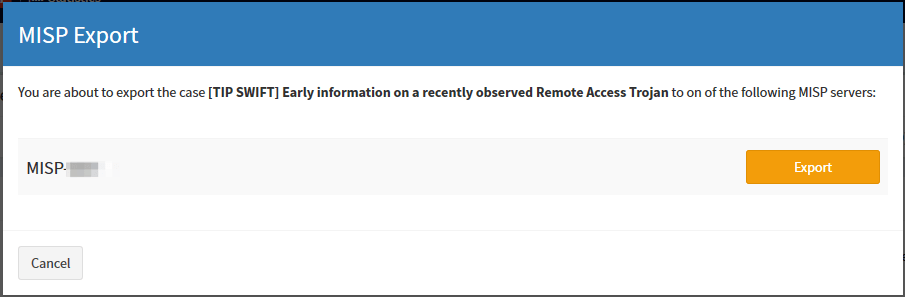
Mellifera 13 can not only import events from multiple MISP servers but also export cases as events to one or several MISP instances. The exported cases will not be published automatically though as they need to be reviewed prior to publishing.
Click on that Share button on the top right cornerSelect the MISP server to which to export the caseSee how the Share counter on the top right corner has now increased
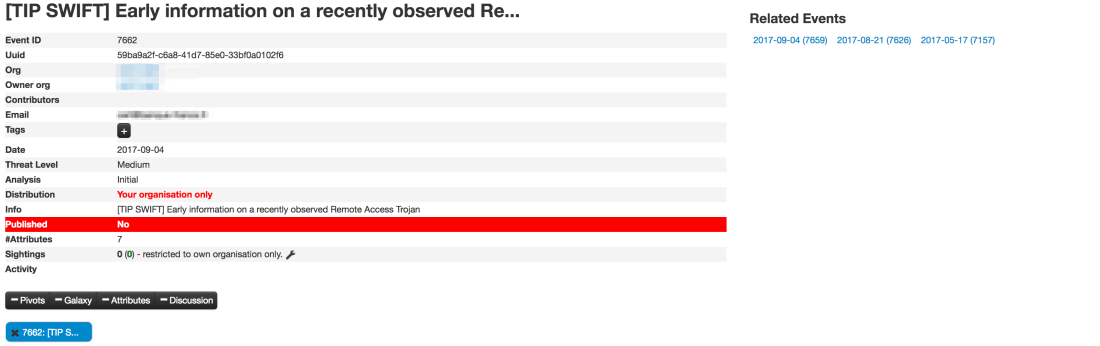
We strongly advise you to review the categories and types of attributes at least, before publishing the corresponding MISP events. Please also note that only and all the observables marked as IOCs will be used to create the MISP event. Any other observable will not be shared. This is not configurable. For further details, check the documentation.
Review and publish the event on MISPReview the categories and types of your attributes
API Keys
Mellifera 13 introduce a new authentication mechanism: API keys. This auth method is recommended for all programs or scripts, including your SIEM, that raise alerts on TheHive. You can, as an administrator, generate and revoke as many API keys as you want. Existing software using the basic authentication method should be modified to use API keys. But do not panic, while the basic authentication mechanism has been disabled by default, you can still enable it in application.conf.
The ‘alert’ role
A new alert role has been added. Only users with this role can create an alert. All existing programs which create alerts must have this role. Otherwise they will no longer work.
Download & Get Down to Work
If you have an existing installation of TheHive, please follow the migration guide. This is paramount to ensure a good transition from earlier versions. You have been warned.
If you are performing a fresh installation, read the installation guide corresponding to your needs and enjoy. Please note that you can install TheHive using an RPM or DEB package, use Docker, install it from a binary or build it from sources.
Support
Something does not work as expected? You have troubles installing or upgrading? No worries, please join our user forum, contact us on Gitter, or send us an email at support@thehive-project.org. We are here to help.
Great, palatable recipes, even if they are cooked by fine French chefs, need to be refined over time and may not be as savoury as intended when they are served in their early days. Quality takes time, although smokeware vendors would have you think otherwise.
Mellifera 12.1 (TheHive 2.12.1) has been released to fix a number of outstanding bugs:
#254: TheHive does not send the file’s name when communicating with Cortex
#255: merging an alert into an existing case does not merge the alert description into the case’s description
#257: while TheHive does not let you add multiple attachments to a single task log, the UI makes you believe otherwise
#259: fix an API inconsistency. GET /api/case/task/:id/log has been fixed.
And a new API call POST /api/case/task/:taskId/log/_search has been added, which accepts a “query” in the request body to filter logs of the task.
#268: cannot create an alert if the IOC field is set for a single alert’s attribute.
#269: closing a case with an open task does not dismiss it from ‘My Tasks’.
This new minor release adds the following enhancements:
#272: in alert preview, similar cases are shown regardless of their status. Merged or deleted ones should not appear in that list.
How About the Test VM?
The test VM has not been updated yet. It still contains Mellifera 12 (TheHive 2.12.0). We will update it in September, probably when Mellifera 13 is released. That version will bring the ability to export cases as MISP events.
Download & Get Down to Work
If you have an existing installation of TheHive, please follow the migration guide.
If you are performing a fresh installation, read the installation guide corresponding to your needs and enjoy. Please note that you can install TheHive using an RPM or DEB package, use Docker, install it from a binary or build it from sources.
Support
Something does not work as expected? You have troubles installing or upgrading? No worries, please join our user forum, contact us on Gitter, or send us an email at support@thehive-project.org. We are here to help.
Rejoice folks! You can now play with TheHive & Cortex thanks to the test VM we created. It includes Mellifera 12, the latest major version of TheHive, Cortex 1.1.3, the latest Cortex analyzers with all dependencies and ElasticSearch installed on top of Ubuntu 16.04 with Oracle JRE 8.
The test VM is intended to be used… well… for testing or training purposes. We strongly encourage you to refrain from using it for production.
Get It
You can download the VM from the following location:
click on Import templates button and select the downloaded package
Plug it with MISP
The test VM does not contain a MISP instance and none is configured in TheHive’s configuration file. To play with MISP, you may want to use the VM our good friends at CIRCL provide. Once you’ve downloaded it or if you have an existing instance, edit /etc/thehive/application.conf and follow the configuration guide.
Restart or Go Mad
After each modification of /etc/thehive/application.conf do not forget to restart the service:
$ sudo service thehive restart
Troubles?
TheHive service logs are located in /var/log/thehive/application.log.
Configure Cortex
All available analyzers are installed with their dependencies, but none is configured. To configure analyzers, edit /etc/cortex/application.conf and follow the configuration guide.
Restart or Go Mad
After each modification of /etc/cortex/application.conf do not forget to restart the service:
$ sudo service cortex restart
Troubles?
Cortex service logs are located in /var/log/cortex/application.log.
Need Help?
Something does not work as expected? No worries, we got you covered. Please join our user forum, contact us on Gitter, or send us an email at support@thehive-project.org. We are here to help.
Correction: July 8, 2017
An earlier version of this post offered to download the VM from Dropbox but they suspended the associated link due to seemingly heavy traffic. The post was updated to replace the Dropbox link with a Google Drive one.
It’s a sunny week in Paris, France (not Texas) barring the tropical rain that washed out the city earlier this morning. And when there’s sun in France, there’s happiness and… coding of course (what else?). The French Chefs of TheHive Project seem to be in a good mood (n’est-ce pas Jérôme ?), thanks to the vitamin D extra charge they got for free from the big star up above.
Version 1.2.2 of the Python API client for TheHive is now available. It mainly fixes issues related to missing Python dependencies and adds support for creating alerts containing files for Python 3.
To update your existing package:
$ sudo pip install thehive4py --upgrade
If you are just getting started with TheHive4py, you can forgo the --upgrade at the end of the command above.
Houston? Are you There?
Shall you encounter any difficulty, please join our user forum, contact us on Gitter, or send us an email at support@thehive-project.org. As usual, we’ll be more than happy to help!
Ahead of the imminent release of Mellifera 12 (TheHive 2.12.0), a new, major (as in MAJOR) version of your (soon to be?) favorite Security Incident Response Platform, we’ve made rather significant changes to Cortex analyzers and released a new version of the CortexUtils Python library.
Adjust the Cortex configuration for the new MISP 2.0 analyzer and for Hippocampe as shown below if you are using these analyzers then import the corresponding report templates into TheHive:
click on Import templates button and select the downloaded package
CortexUtils 1.2.0
CortexUtils has been updated to include a new function called build_taxonomy() which is required for analyzers relying on the Python library we released to make their development development easier.
Mini-Reports in The Observable Tabs
Starting from Mellifera 12 (TheHive 2.12.0), mini-reports will be displayed in the observable tab in each case as soon as an analysis has been completed. Now analyzers compute their short/mini reports and put them in the summary section of their JSON output, ready for consumption. TheHive 2.12.0 and up will no longer create them on-the-fly.
Taxonomy
The mini-reports of all the analyzers have been updated to comply with a taxonomy that is similar to the one we were already using for VirusTotal: VT:Score="14/56”. A “maliciousness” level was already included in TheHive’s analyzer templates and we used a specific color to display each level. This level is now produced directly by the analyzers:
info / blue: the analyzer produced an information, and the short report is shown in blue color in TheHive.
safe / green : the analyzer did not find anything suspicious or the analyzed observable is safe (according to the analyzer). TheHive displays the short report in green color.
suspicious / orange : the analyzer found that the observable is either suspicious or warrants further investigation. The short report is orange colored in TheHive.
malicious / red : the analyzer found that the observable is malicious. The short report is displayed by TheHive in red color as show below:
The short report is built with the summary() function of an analyzer. The build_taxonomy() of cortexutils mentioned earlier should help building it.
MISP 2.0
The MISP analyzer has been updated to version 2.0 and includes new functionality submitted by our long-term contributor Nils Kuhnert from CERT-Bund (thanks a heap!). Unlike the previous version, v 2.0 will let you search for an observable in multiple MISP servers at the same time.
The analyzer accepts a truckload of datatypes as input. To make it work, install the pymispPython library. It should already have been installed if you are just updating your current analyzers. You will also have to change Cortex configuration file (application.conf) for this new version:
Important note: You have to adjust your existing configuration to match the one shown above. The certpath variable can be left blank if you are not using a self-signed certificate.
When called from TheHive, the following output is produced:
TheHive: MISP 2.0 Analyzer – Short and Long Report Samples
The short report will show the number of unique events found in all MISP servers while the long report will show information of each matching event in each MISP server.
CERTatPassiveDNS
The CERTatPassiveDNS analyzer is a new submission by Nils (thanks again). It lets you check the CERT.at PassiveDNS service for a given domain or hostname. It takes domains and FQDN as input.
Access to the CERT.at service is allowed to trusted partners only. If you think you qualify, please contact CERT.at. You do not need to add specific information into the Cortex configuration file to benefit from this analyzer as it calls the whois system command to perform the pDNS requests.
When called from TheHive, the following output is produced:
TheHive: CERTatPassiveDNS Analyzer – Short and Long Report Samples
Miscellaneous
The latest version of the Cortex-analyzers repository also include the following bug fixes and improvements:
#61: fix typos in two requirements.txt files – by Michael Salsone
#65: update the Joe Sandbox analyzer’s long report to support version 19.0.0
#67: fixed mistake in the FireHol analyzer – by Nils Kuhnert
#69: use http://server:port for Hippocampe instead of http://server:port/hippocampe/api/v1.0/
Running Into Trouble?
Shall you encounter any difficulty, please join our user forum, contact us on Gitter, or send us an email at support@thehive-project.org. We will be more than happy to help!
Correction: July 6, 2017
An earlier version of this post mispelled Nils Kuhnert’s last name.





 TheHive Project