We are proud to announce the immediate availability of Cerana 0.9 (TheHive 3.0.9) and Cortex 2.0.4. These hotfix releases address a number of issues and we encourage you to update your current installation at your earliest opportunity. For your comfort and sanity. Seriously.
We also took this opportunity to update Cortex analyzers to fix issues with CIRCL Passive SSL, Hybrid Analysis, and the Joe Sandbox URL Analysis template. Moreover, we have updated the cortexutils library to set the taxonomy level to info if it is invalid. To upgrade cortexutils to 1.2.4:
Note: the Bluecoat analyzer was removed since it does not comply with the updated Terms of Service of Symantec Web Pulse SiteReview. Symantec does no longer permit programmatic querying of the service.
Fixes in Cerana 0.9
#527: display long reports when the analyst clicks on the corresponding short reports. Meh!
#541: make the drop-down menu for case templates scroll when there is a truckload of them.
Something does not work as expected? You have troubles installing or upgrading? Spotted new bugs? No worries, please open issues on GitHub or comment on existing ones, join our user forum, contact us on Gitter, or send us an email at support@thehive-project.org. We are here to help.
Correction: April 14, 2018 An earlier version of this post did not mention that the Bluecoat analyzer was removed in the latest Cortex Analyzers repository release.
There’s a new version of your ultimate observable analysis engine in town : Cortex 2.0.3 is out!
Cortex 2.0.3 contains a few important enhancements over its predecessor and fixes a number bugs as described in the full changelog summarised below. So get it while it’s still hot out of the digital oven and let us know how tasty it is.
Source : Quickmeme.com
Implemented Enhancements
#81: reflect proxy changes in the global configuration at the analyzer level
#82: display invalid analyzers and let orgadmins delete them
#85: allow orgadmins to override the default global report cache.job period per analyzer through the Web UI
#75: a version upgrade of an analyzer makes all analyzers invisible in TheHive
#80: fix the analyzer configuration dialog to allow orgadmins to override the auto artifact extraction at the analyzer level
#83: hit Nabil on the head pretty hard until the analyzer refresh UI button works (well now it does so you can stop hitting poor Nabil’s head).
Analyzer Updates
We took the opportunity of a new release to make a few updates to the public analyzers. Cortex-Analyzers 1.9.3 contains the following changes:
Remove the Bluecoat analyzer to comply with the new ‘no scrapping’ ToS imposed by Symantec
Fix the default configuration of the Cymon Check IP analyzer
Fix the View all VT long template
Make the MISP Warning Lists Analyzer ignore case sensitivity when searching for hashes
Restrict the Abuse Finder and FileInfo analyzer dependencies to Python 2.7
You can read the full changelog if you like but if you want to enjoy the goods right away, git pull is your friend.
Support
Something does not work as expected? You have troubles installing or upgrading? Spotted new bugs? No worries, please open issues on GitHub or comment on existing ones, join our user forum, contact us on Gitter, or send us an email at support@thehive-project.org. We are here to help.
After announcing Cortex 2.0.0 and TheHive 3.0.7, the first version of your favorite SIRP that is (supposedly) compatible with the brand-new version of Cortex, last week, we thought it was time to relax and enjoy the upcoming, long Easter weekend, the sunny sky of Paris (if you can pierce the veil of the Forever Grey Cloud™ that is hanging over the city of lights), and great jazz music. Heck, I even tweeted about it … only to be proven wrong by Life (and Murphy).
We literally field tested Cortex 2 for 3 weeks, we squashed bugs here and there, until almost the very last minute before the release. And yet, our QA needs to be improved by leaps and bounds as we had to release Cortex 2.0.1 one day after unveiling 2.0.0 to correct some additional bugs. And then some members of the core team and of our growing user community took it for a spin. And all hell broke lose. Well, almost 🙂
Session collisions (when TheHive and Cortex 2 are used on the same machine), analyzer malfunctions, connectivity problems … issues that were not identified during the testing phase, even in a production environment, where everything worked as expected. And we call this ‘Computer Science’. Right, right…
So we worked hard, took out our Code Hammer (it’s like Thor’s but cyber) and blasted away all the bugs that we found out or that were reported to us (arigato gozaimasu!) and we are happy to announce the immediate availability of Cortex 2.0.2, TheHive 3.0.8, Cortexutils 1.2.3 and Cortex-Analyzers 1.9.2.
TL;DR Install or upgrade Cortex 2.0.2, update Cortexutils, git pull the Cortex-analyzers repo to get the latest version of the repository, upgrade to TheHive 3.0.8, follow the Quick Start Guide and have a drink.
If you have time (which is admittedly quite scarce nowadays), please read on the changelogs:
As stated in the previous post, we will release a new version of Cortex4py in order to make it compatible with Cortex 2, continue the work we started with our MISP Project friends to support MISP attribute enrichment through Cortex 2 (MISP currently only supports enrichment using Cortex 1), and perform a long-overdue overhaul of our documentation. We will also release a brand new version of TheHive4py.
Last but not least, we’ll take a hard look at ourselves and our QA. You expect us from us high quality and we hold ourselves to high standards. And we will deliver.
Support
Something does not work as expected? You have troubles installing or upgrading? Spotted new bugs? No worries, please open issues on GitHub or comment on existing ones, join our user forum, contact us on Gitter, or send us an email at support@thehive-project.org. We are here to help.
TheHive Project’s Master Chefs are extremely happy to share, for free their latest recipe with the Cyber Threat Intelligence, Digital Forensics and Incident Response communities: Cortex 2.
As its predecessor, Cortex 2 is published under an AGPL v3 license and it introduces many important features that we brushed upon in a Dec 2017 post.
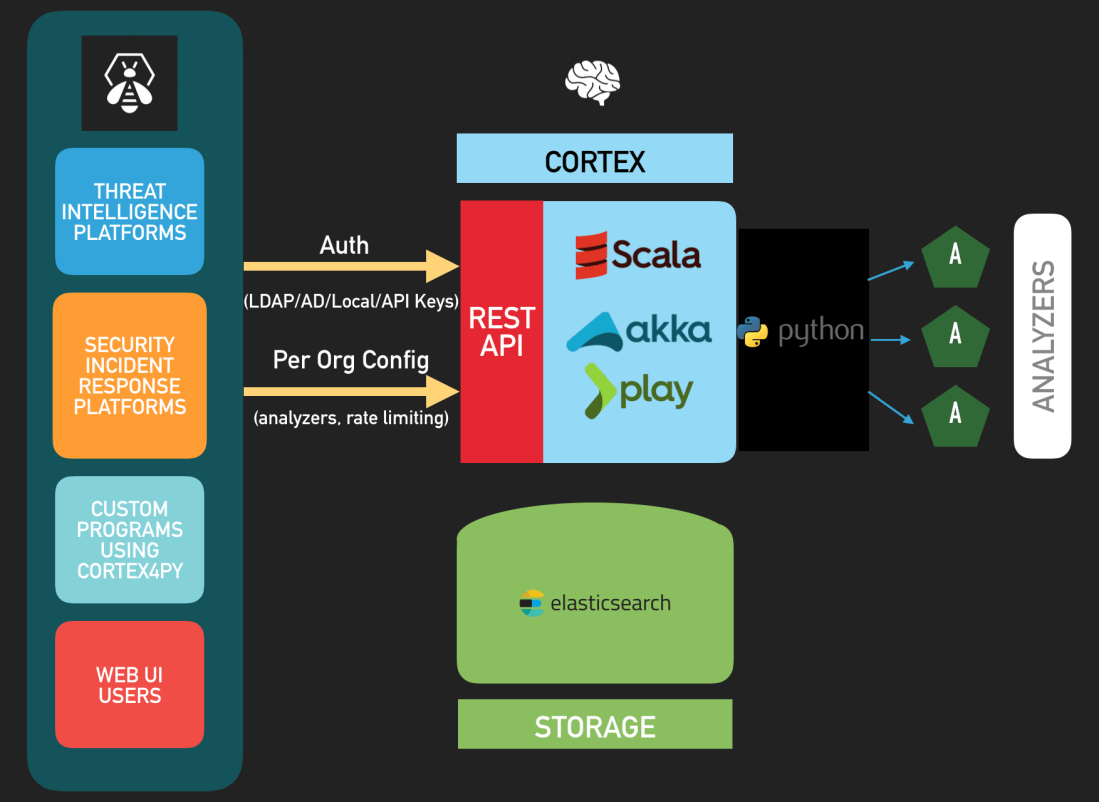
Cortex 2 — Architecture
Update: Cortex 2.0.1 was released since this post went live. It corrects a few bugs we uncovered in 2.0.0 as described in the changelog. Please install Cortex 2.0.1 instead of 2.0.0.
Authentication
Cortex 2 supports all the authentication methods that TheHive supports: LDAP, Active Directory, local accounts, API Keys, and X.509 SSO.
To connect your favorite Security Incident Response Platform with Cortex 2, you will need to update TheHive to Cerana 0.7 (TheHive 3.0.7) which was released today as well. This version fixes a regression pertaining to case templates introduced by Cerana 0.6 and is the first version to fully support Cortex 2’s API changes and authentication.
To make TheHive 3.0.7 analyze observables at scale through Cortex 2, you have to create an account on Cortex 2 with the read and analyze roles (see the next section) and generate the associated API Key. Next, feed the key in TheHive’s /etc/thehive/application.confas described in the documentationet voilà !
TheHive 3.0.7 remains compatible with Cortex 1 and you can connect it to a mixed set of Cortex 1 and/or Cortex 2 instances with no issues.
Organizations, Analyzers and Rate Limiting
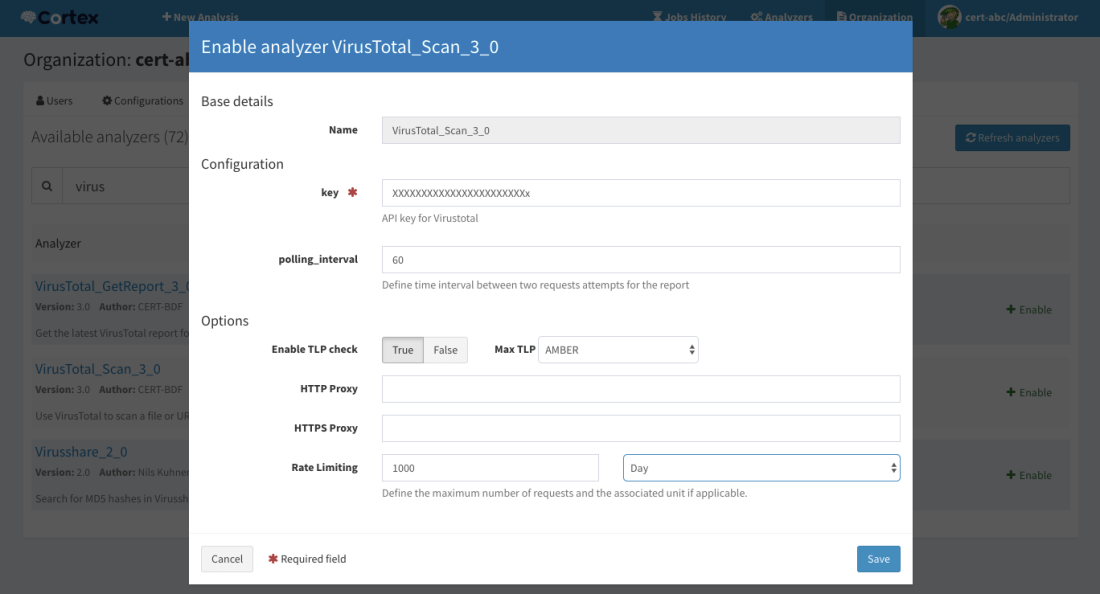
Cortex 2 introduces multi-tenancy through organizations and each organization can have its own set of users, with different roles, its own set of analyzers and, if necessary, rate limits that will prevent analysts from burning quotas.
Multi-tenancy has several interesting use cases. For instance, if you are the CSIRT or CERT of a large multinational organization with several regional teams, you can create an organization for each region within your constituency and enable the analyzers that they may need to use. Let’s assume that you bought a VirusTotal subscription that limits you to 5000 requests per month. You can configure the corresponding analyzers to give each region a fair share of that quota and keeping some requests for your own use.
In case you are a commercial CSIRT or an MSSP, you could do the same for your customers by installing only one Cortex 2 instance and creating an organization for each customer.
Configure an analyzer graphically and impose rate limits if necessary
User Roles
By default, Cortex 2 is shipped with the default cortex organization which sole purpose is to create other ones and manage the users within each organization and their associated powers. The cortex organization hosts all users with the superAdmin role and it cannot be used to configure or run analyzers.
As described in the new Quick Start Guide, after installing Cortex 2, updating its database and creating the first user who will have super admin powers, you’ll have to create your first organization and at least one user within that organization with orgAdmin rights.
Create an organization
You can then log out and log in using the orgAdmin account to create further users within that organization, enable and configure analyzers etc. Please note that no analyzer is enabled by default and you need at least v 1.9.0 of the cortex-analyzers repository. To update your set of analyzers to 1.9.0, please run git pull.
Manage users within an organization
Besides the superAdmin and orgAdmin roles, Cortex 2 introduces the read role which allows users to access analyzer reports and read them but not execute analyzers. For that, users need the analyze role (which implies the read role). orgAdmin users can also run analyzers. superAdmin users are limited to the default cortex organization. While they can create organizations and manage users within them, they cannot access analyzer configurations such as confidential API keys or job reports.
Job reports
Report Persistence and Caching
Cortex 2 relies on Elasticsearch 5.x to store many configuration items but also all the analyzer reports that have been generated. Unlike its predecessor, you won’t lose your existing reports should you need to restart the service or the host it is running on.
Cortex 2 also introduces report caching. By default the cache.job parameter is set to 10 minutes in /etc/cortex/application.conf. That means that if an analysis on a given observable with a defined TLP is requested and that a report has been previously generated in the last 10 minutes, Cortex 2 will serve that report instead of running a new analysis. This feature can help prevent soliciting analyzers, particularly those which require a subscription or have quotas, when there is no need to do so. Please note that this parameter is global to all the analyzers and all the organizations that are configured in the Cortex 2 instance. We do have plans to make it more granular in future versions.
Migrating from Cortex 1
If you are migrating from Cortex 1.x, we recommend that you:
Save the configuration of your analyzers (which ones are enabled and what their configuration items are, such as users/passwords or API keys).
Install Cortex 2.
Edit /etc/cortex/application.conf to add the secret key as shown in Step 1 of the Quick Start Guide and point Cortex to the location of the analyzers.
Follow the remaining steps of the Quick Start Guide to enable the analyzers you need and reinject their configuration.
What’s Next?
In the upcoming weeks, we will release a new version of Cortex4py in order to make it compatible with Cortex 2, continue the work we started with our MISP Project friends to support MISP attribute enrichment through Cortex 2 (MISP currently only supports enrichment using Cortex 1), and perform a long-overdue overhaul of our documentation.
Feeling Generous? Donate!
As you know, we are a FOSS project and donations are always welcome to make our products even better for the community.
All donations go to Creative Source, the non-profit organization we have created, and we will use them to improve TheHive, Cortex & Hippocampe but also to develop (even better) integrations with other FOSS solutions such as MISP.
Creative Source can also provide so-called professional, entreprise-grade support, help integrating the products, train your analysts before they drain or assist you in specific areas such as developing in-house analyzers for Cortex.
Support
Something does not work as expected? You have troubles installing or upgrading? No worries, please join our user forum, contact us on Gitter, or send us an email at support@thehive-project.org. We are here to help.
Correction: March 30, 2018 Instructions on how to update the cortex-analyzers have been added. Also, Cortex 2.0.1 was released to correct a few bugs in the previous version since this post went live.
Update: Cerana 0.5 (TheHive 3.0.5) was released on Feb 8, 2018 to fix a regression introduced by Cerana 0.4, pertaining to the observable mini-reports. Please install 3.0.5 instead.
Waiting for the menu, one of the numerous guests of TheHive Project’s world-renowned code restaurant grows impatient. He stands up and walks toward the kitchen, looking for a waiter to chastise. It’s certainly a free meal and, looking at the reviews on CodeAdvisor, a delicious one. But guests shouldn’t wait more than two minutes to get a copy of the menu, right?
As he approaches the door leading to the kitchen, it slams open and an all-smiling, all-French-looking man dressed in a bee costume comes out carrying hot plates. Peering at their content, the once angry guest cheers up as he stares down at Cerana 0.4 or TheHive 3.0.4 if you prefer. If the looks and smells of the dish match its taste, this will be a terrific meal.
As he sees how Cerana 0.4 prompted a change of heart of the guest, the waiter coming out of the kitchen where TheHive Chefs were busy creating this new recipe goes on describing its content.
‘Mon bon Monsieur‘, he starts in near-perfect Parisian-English accent, ‘this is the plat du jour, or the dish of the day if you prefer. Even though the mighty Chefs insist on calling it a hotfix, not only it fixes eleven bugs in previous versions but it adds four new features and two enhancements. Would you like me to describe them?’
The guest, feeling hungry, his mouth watery, but feeling bad about what he was about to say to the waiter just a few seconds ago nods. So the waiter goes on and describe how the latest release of TheHive will serve his hunger for efficient though free security incident response platforms even better.
Fix a nasty issue where the assignee list is not displayed when there are more than 20 users. This was impacting all drop down lists than contain dynamic data.
An alert is uniquely identified by a tuple: type; source; sourceRef. However, the type parameter was simply ignored. Nice fail (*cough*).
When a report template is not defined for a given analyzer, TheHive tries to load a default one that shows the raw job report. However, the path to that default template was broken.
Last but not least, filter MISP events using MISP tags & more before creating alerts. That way, you won’t have to deal with a mind-numbing number of alerts when you connect an event-loaded MISP instance to TheHive for the first time. Please check out the documentation to leverage this nifty feature.
At this point, the guest cannot control his lust so he snatches one of the plates out the waiter’s hands, runs back to his table and start installing Cerana 0.4 to unleash its power and use it to fight cybercrime. Bon appétit !
Feeling Generous? Donate!
As you know, we are a FOSS project and donations are always welcome to make our products even better for the community.
All donations go to Creative Source, the non-profit organization we have created, and we will use them to improve TheHive, Cortex & Hippocampe but also to develop (even better) integrations with other FOSS solutions such as MISP.
Creative Source can also provide so-called professional, entreprise-grade support, help integrating the products, train your analysts before they drain or assist you in specific areas such as developing in-house analyzers for Cortex.
Download & Get Down to Work
If you have an existing installation of TheHive, please follow the migration guide.
If you are performing a fresh installation, read the installation guide corresponding to your needs and enjoy. Please note that you can install TheHive using an RPM or DEB package, use Docker, install it from a binary or build it from sources.
Support
Something does not work as expected? You have troubles installing or upgrading? No worries, please join our user forum, contact us on Gitter, or send us an email at support@thehive-project.org. We are here to help.
Correction: Feb 6, 2018 An earlier version of this post contained an incomplete sentence.
Two months ago, TheHive Chefs announced that Cortex passed the 30 analyzers mark as they added HybridAnalysis, EmergingThreats and Shodan, all three contributed by our continuously growing user community.
It’s 2018 already and to wish you a very happy new DFIR year, Nils and Jérôme got out of their way and reviewed many outstanding pull requests for new analyzers and fixed several bugs. Kudos bees!
The latest release of Cortex-Analyzers, v 1.8.0, contains not one, not two, not even three but ten new analyzers! Isn’t that good omen for a fresh new year fighting cybercrime?
The ten new analyzers, described below, are:
Bluecoat: contributed by our longtime friends from CERT La Poste.
MISP WarningLists: Nils strikes again (watch out Jérôme! the youngster is gonna leave you way behind ;).
Onyphe: contributed by Pierre Baudry and Adrien Barchapt. It comes in five different flavors.
PayloadSecurity: submitted by Emmanuel Torquato. The analyzer comes in two flavors.
Robtex: added by… Nils again! It has three flavors.
SinkDB: guess who developed that one? Wow, impressive! How did you figure it out? Yes, Nils!
Tor Blutmagie: contributed by Marc-André Doll.
Tor Project: also contributed by Marc-André Doll.
We would like to wholeheartedly thank all the individuals and teams listed above for their invaluable contributions. So a big merci for your work!
Bluecoat
The Bluecoat analyzer queries the Symantec – previously known as Bluecoat – WebPulse site review API for the currently assigned site category of URLs or domains. The analyzer needs no further configuration. When executed through TheHive, the analyzer produces short and long reports as shown below:
TheHive: Bluecoat 1.0 Analyzer – Short and Long Report Samples
C1fApp
The C1fApp analyzer queries the C1fApp service, an Open Source threat feed aggregation application, using the API for IP addresses, domains and URL.
Before using the analyzer, you need to create an account on the C1fApp website and get the associated API key which you’ll need to provide as a value for the key parameter of the analyzer config section of /etc/cortex/application.conf as shown below. Once you’ve done so, you’ll need to restart Cortex.
 C1fApp {
     service="query"
     key="<insert API key here>"
     url="https://www.c1fapp.com/cifapp/api/"
 }
When launched using TheHive, the analyzer produces short and long reports such as the following:
TheHive: C1fApp 1.0 Analyzer – Short and Long Report Samples
Censys.io
Censys.io continually monitors every reachable server and device on the Internet, so you can search for them and analyze them in real time. Using the corresponding analyzer, information about a website certificate can be obtained using the associated IP, domain or certificate hash.
In order to use this analyzer, an account at censys.io has to be registered and the API ID and secret need to be added to the Cortex configuration file:
Censys {
    uid="<Your ID here>"
    key="<Your secret here>"
}
Once done, you’ll have to restart Cortex. When ran from TheHive, the analyzer produces short and long reports such as the following:
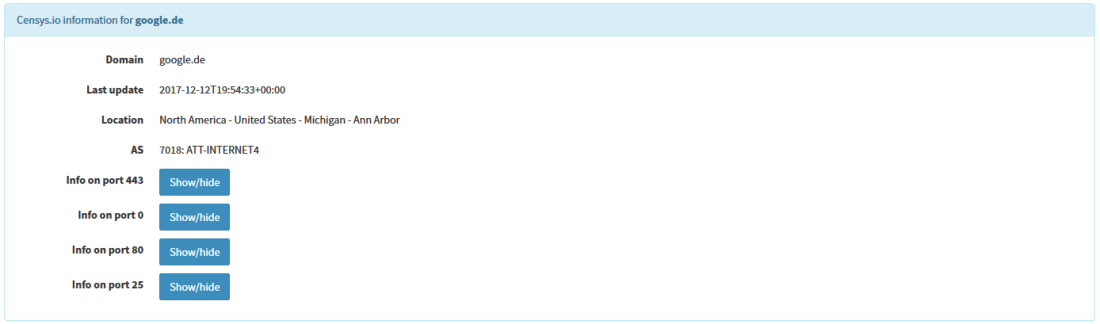
TheHive: Censys 1.0 Analyzer – Short and Long Report Samples
Details about the ports can be obtained with a click on the specific button.
MISP WarningLists
In order to detect false positives soon enough in the analysis process, our good friends at the MISP Project published their so called warning lists which contain lists of well-known services or indicators.
This analyzer queries observables against the MISP warning lists. Observables can be an IP address, a hash, a domain, a FQDN or a URL.
To iterate through all the warning lists, the repository itself must be available on the Cortex instance:
We highly recommend you create a cron entry or use a similar mechanism to keep the lists fresh. While the default path for the lists is the misp-warninglists subdirectory it can be adjusted in the configuration file:
When called from TheHive, the analyzer produces short and long reports as shown below:
TheHive: MISP WarningLists 1.0 Analyzer – Short and Long Report Samples
As you can see, The MISP WarningLists analyzer checks if the repository is up-to-date 😉
Onyphe
The Onyphe analyzer leverages Onyphe’s API to query the service, which provides data about the IP address space and the publicly available information in a single, handy location.
The service comes in five flavors:
Onyphe_Forward: retrieves forward DNS lookup information we have for the given IPv4/IPv6 address with history of changes.
Onyphe_Geolocate: retrieves geolocation information for the given IPv4/IPv6 address.
Onyphe_Ports: retrieves synscan information we have for the given IPv4/IPv6 address with history of changes.
Onyphe_Reverse: retrieves reverse DNS lookup information we have for the given IPv4/IPv6 address with history of changes.
Onyphe_Threats: retrieves Onyphe threats information on anIPv4/IPv6 address with associated history.
To use the analyzer, you need to create an account on the Onyphe website. Provide the API key associated with your account as a value for the key parameter and add the lines below to the config section of /etc/cortex/application.conf then restart the cortex service.
Onyphe {
    key = "<insert API key here>"
}
When ran from TheHive, the analyzer produces short and long reports such as the following:
TheHive: Onyphe 1.0 Analyzer – Short and Long Report Samples
PayloadSecurity
The PayloadSecurity analyzer let you submit observables to a on-premises PayloadSecurity instance. To use it, you need to create an account on the PayloadSecurity service. Provide the API/secret pair as values for the key and secretparameters, collect the URL and environmentid of the service, and add the lines below to the config section of /etc/cortex/application.conf. Then restart the cortex service.
When launched through TheHive, the analyzer produces short and long reports such as the following:
TheHive: PayloadSecurity 1.0 Analyzer – Short and Long Report Samples
Robtex
When collecting data about IPs, domains and FQDNs, Robtex can be a good source of information. According to their statistics, they logged over 20 billion DNS resource records. The corresponding analyzer comes in three flavors:
Robtex_Forward_PDNS_Query: checks domains/FQDNs using the Robtex Passive DNS API
Robtex_IP_Query: checks IPs using the Robtex IP API
Robtex_Reverse_PDNS_Query: checks IPs using the Robtex reverse Passive DNS API
The analyzer uses the free Robtex API which needs no subsequent configuration. However, the free API limits the rate and amount of returned data.
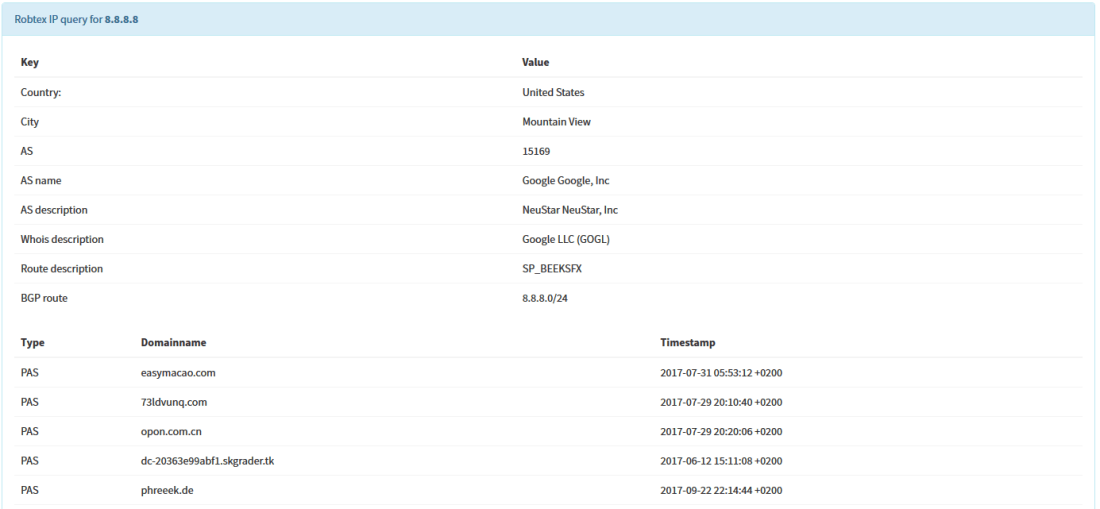
When executed using TheHive, the analyzer produces short and long reports such as the following:
TheHive: Robtex 1.0 Analyzer – Short and Long Report Samples
SinkDB
SinkDB is a private service provided by abuse.ch which collects sinkholed IPs. Access to the service is allowed to trusted partners only. If you think you qualify, you can request an access using the form available on the SinkDB website. This is most likely only granted to certain CSIRTs and CERTs and not to individuals.
Provide the API key associated with your account as a value for the key parameter and add the lines below to the config section of /etc/cortex/application.conf then restart the cortex service.
SinkDB {
    key="<insert API key here>"
}
When ran from TheHive, the analyzer produces short and long reports such as the following:
TheHive: SinkDB 1.0 Analyzer – Short and Long Report Samples
Tor Blutmagie
Tor Blutmagie analyzer extracts data from torstatus.blutmagie.de and checks if an observable is linked to a Tor node. The observable can be an IP address, a FQDN or a domain.
In order to check if an IP, domain or FQDN is a Tor exit node, this analyzer queries the Tor status service at Blutmagie.de. The analyzer uses a caching mechanism in order to save some time when doing multiple queries, so the configuration includes parameters for the cache directory and the caching duration.
Provide the lines below to the config section of /etc/cortex/application.conf then restart the cortex service.
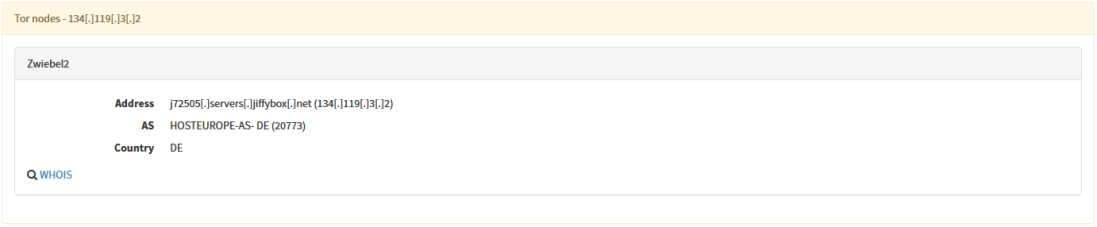
When ran from TheHive, the analyzer produces short and long reports such as the following:
TheHive: Tor Blutmagie 1.0 Analyzer – Short and Long Report Samples
Tor Project
Tor Project analyzer has also been contributed by Marc-André Doll. As the above analyzer, this one checks if an observable is a Tor exit node. This time, however, the source of information is the official Tor network status which can be queried for IP addresses only.
The accepts another parameter, ttl, which is the threshold in seconds for exit nodes before they get discarded. Provide the lines below to the config section of /etc/cortex/application.conf then restart the cortex service.
Shall you encounter any difficulty, please join our user forum, contact us on Gitter, or send us an email at support@thehive-project.org. We will be more than happy to help!
Correction: January 12, 2018
The post was updated to add the full name of the author of the PayloadSecurity analyzer.
TheHive Chefs are happy to announce the immediate availability of their latest recipe: Cerana 0.2 (a.k.a. TheHive 3.0.2).
While TheHive 3.0.0 brought you dynamic dashboards among other niceties, the latest (and, of course, the greatest) version of your Mom’s favourite Security Incident Response Platform fixes a bug spotted by our longtime supporter Megan Roddie (merci !). Indeed, Nabil was running low on coffee so he didn’t make the necessary changes to support the new sighted toggle introduced by Cerana for file observables.
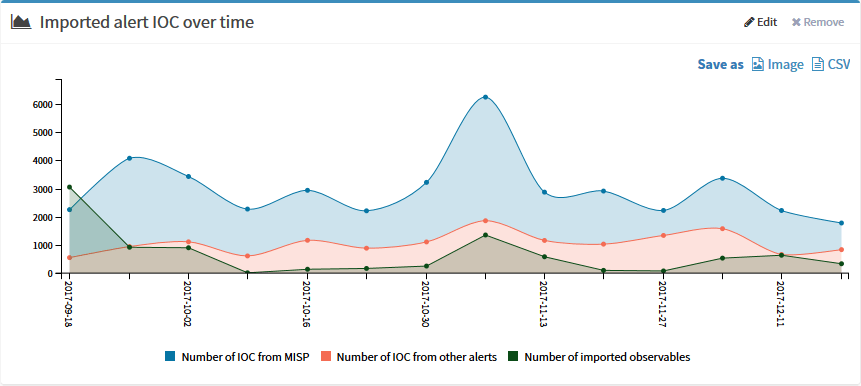
Last but not least, we decided to make dynamic dashboards even more powerful. You can now create new graphs that supportmultiple series from multiple entities (or sources).
Multi-line Dashboards Example — Number of IOCs imported from MISP vs. those imported from other sources
As Christmas is approaching, go ahead and play with dynamic dashboards to impress your management as soon as 2018 rears its head or truly drive your CTI and DFIR activities and plan well ahead how you should improve automation or collaboration (or beg for additional headcount).
Multi-line Dashboards Example — How to create one
Ain’t that nifty? Who said bees aren’t nice? Joyeux Noël !
Feeling Generous? Donate!
As you know, we are a FOSS project and donations are always welcome to make our products even better for the community.
All donations go to Creative Source, the non-profit organization we have created, and we will use them to improve TheHive, Cortex & Hippocampe but also to develop (even better) integrations with other FOSS solutions such as MISP.
So if you are feeling generous, contact us at support@thehive-project.org. Of course the funds may also be used to keep Nabil happy by providing a steady flow of caffeine. 😉
Creative Source can also provide so-called professional, entreprise-grade support, help integrating the products, train your analysts before they drain or assist you in specific areas such as developing in-house analyzers for Cortex.
Download & Get Down to Work
If you have an existing installation of TheHive, please follow the migration guide.
If you are performing a fresh installation, read the installation guide corresponding to your needs and enjoy. Please note that you can install TheHive using an RPM or DEB package, use Docker, install it from a binary or build it from sources.
Support
Something does not work as expected? You have troubles installing or upgrading? No worries, please join our user forum, contact us on Gitter, or send us an email at support@thehive-project.org. We are here to help.
The Chefs who’ve been working hard to create delicious recipes in TheHive Project’s code kitchen are happy to announce the establishment of Creative Source, anon-profit organization, which aims to support TheHive, Cortex and Hippocampe.
Who’s behind this NPO?
Creative Source is co-managed by all the members of TheHive Project’s core team: Nabil Adouani, Thomas Franco, Danni Co, Saâd Kadhi and Jérôme Léonard. Work is in progress to provide Creative Source with a Web face.
What Will you Provide through It?
We have already started working with a couple of large organizations to provide trainings, limited support and assistance in Cortex analyzer development. All the money Creative Source is going to gain will serve to further support the project and keep refining our recipes to make them even more palatable.
If you are interested in funding the project, training your analysts or if you are looking for professional assistance with our products, please contact us at support@thehive-project.org.
Will TheHive, Cortex and Hippocampe Stay Free?
Don’t you dare ask that question! TheHive, Cortex and Hippocampe will stay free and open source in the foreseeable future as we are deeply committed in helping the global fight against cybercrime to the best of our abilities.
New Ally
We are also very happy to announce that Nils Kuhnert (a.k.a. @0x3c7 on Twitter), a longtime contributor, has now joined TheHive Project! We are no longer a pure French project, damn! 😉
Nils, who created many analyzers, will work mainly with Jérôme to deal with existing and new ones and absorb the numerous pull requests that have been piling up for many months. Welcome on board Nils!
New Home
Author : Saâd Kadhi
To accommodate Nils and future members, our code and documentation will leave the lofty shelter of CERT-BDF‘s Github and move to https://github.com/orgs/TheHive-Project/ on Wed Dec 20, 2017. Save the date folks!
Version 1.4.0 of the Python API client for TheHive is now available. It is compatible with the freshly released Cerana (TheHive 3.0.0).
We’d like to thank Nick Pratley, a frequent contributor, Bill Murrin, Alexander Gödeke and “srilumpa” for their code additions and documentation.
To update your existing package:
$ sudo pip install thehive4py --upgrade
If you are just getting started with TheHive4py, you can forgo the --upgrade at the end of the command above.
New Features
#5: Add a method to update a case, contributed by Nick Pratley
#34: Add a get_task_logs method in order to obtain all the task logs associated with a given taskId. Contributed by Bill Murrin
#37: A new, very cool case helper class by Nick Pratley
#39: Add support for custom fields to the case model
#40: Ability to run a Cortex analyzer through the API by Alexander Gödeke
#45: Simplify case creation when using a template by providing just its name
#49: Add a query builder capability to support TheHive’s DSL query syntax
Paris? Are you There?
Shall you encounter any difficulty, please join our user forum, contact us on Gitter, or send us an email at support@thehive-project.org. As usual, we’ll be more than happy to help!
Update: 2 days after publishing this blog post, we’ve released Cerana 0.1 (TheHive 3.0.1) which fixes a number of issues. We encourage you to use 3.0.1 instead of 3.0.0.
The friendly honeybees at TheHive’s code kitchen were pretty busy lately even though winter came and temperatures have been close to zero Celsius in Paris, France. As we wrote a couple of weeks ago on this very blog, we are happy to announce Cerana to the world, available immediately.
Cerana or TheHive 3.0.0 is the latest (and obviously greatest) release of a now highly popular open source, free Security Incident Response Platform (or SIRP for short). Its flagship feature in comparison to previous releases is Dynamic Dashboards.
Dynamic Dashboards
Dynamic Dashboards replace the Statistics module in Cerana to allow you to explore the data available in Elasticsearch, which TheHive uses for storage, in many ways. For example, you can have a usage breakdown of Cortex analyzers, the number of open cases per assignee, the number of alerts per source (MISP, email notifications, DigitalShadows, Zerofox, Splunk, …), the number of observables that have been flagged as IOCs in a given time period, how many attributes were imported from MISP instances, top 10 tags of imported MISP attributes or incident categories.
Dynamic Dashboards
Dynamic Dashboards can be created by an analyst and kept private or shared with the other team members. Dashboards can also be exported and imported into another instance. This would facilitate community participation in the establishment of valuable data exploration graphs to drive DFIR activity and seek continuous improvement.
When you’ll migrate to Cerana, you won’t have to build dashboards from scratch. We recreated more or less those which were available under the Statistics view and included them in the Cerana build.
Cortex and MISP Health Status
Cerana will also allow you to monitor the health status of all the Cortex and MISP instances that it is connected to. In the bottom right corner of TheHive’s Web UI, the Cortex and MISP logos appear when you have configured the integration with those products as in previous releases. However, the logos will have a small outer circle which color will change depending on whether Cortex and/or MISP instances are reachable or not.
Cortex & MISP Health
If TheHive can’t reach N out of M Cortex/MISP instances, the outer circle will be orange. If it can’t reach all M instances, the circle will red. If everything is fine, the circle will be green. The exact status of each Cortex/MISP instance can be seen in the About page. And when you try to run analyzers on a Cortex which cannot be reached, TheHive will tell you so as well.
Cortex & MISP: Version & Status
Sighted IOCs
In previous releases of TheHive, observables can be flagged as IOCs. However, this doesn’t necessarily mean you’ve seen them in your network. Think for example of a suspicious attachment which you’ve submitted to Cuckoo or Joe Sandbox through Cortex. The analyzer returns some C2 addresses to which the sample tries to connect to. You’d be right to add those C2 addresses to your case and flag them as IOCs. Then you search for them in your proxy logs and you find connection attempts to one out of four. In previous versions, you’d add a seen label but this would be inconsistent among analysts. One may use found instead. Another will add a description and no labels.
To avoid such situations and give you a simple way to declare an IOC as seen, Cerana adds a sighted toggle which you can switch on/off. We will leverage this toggle in future versions to indicate sightings when sharing back cases to MISP.
Other Features and Improvements
Cerana contains numerous other features and improvements such as:
Case template import, export
The ability to assign default values to metrics and custom fields to case templates
The ability to assign by default tasks to their rightful owners in case templates
Show already known observables when previewing MISP events in the Alerts page
Add autonomous systems to the list of default datatypes
Single-sign on using X.509 certificates (in BETA currently)
We will update the documentation for Cerana in the upcoming weeks. So stay tuned.
Download & Get Down to Work
If you have an existing installation of TheHive, please follow the migration guide.
If you are performing a fresh installation, read the installation guide corresponding to your needs and enjoy. Please note that you can install TheHive using an RPM or DEB package, use Docker, install it from a binary or build it from sources.
Support
Something does not work as expected? You have troubles installing or upgrading? No worries, please join our user forum, contact us on Gitter, or send us an email at support@thehive-project.org. We are here to help.























 TheHive Project