All Fresh CortexUtils, New Cortex Analyzers

Ahead of the imminent release of Mellifera 12 (TheHive 2.12.0), a new, major (as in MAJOR) version of your (soon to be?) favorite Security Incident Response Platform, we’ve made rather significant changes to Cortex analyzers and released a new version of the CortexUtils Python library.

TL;DR

If you are in a hurry:

$ sudo pip install cortexutils --upgrade
$ cd where/your/analyzers/are
$ git pull master

Adjust the Cortex configuration for the new MISP 2.0 analyzer and for Hippocampe as shown below if you are using these analyzers then import the corresponding report templates into TheHive:

  • download the updated package
  • log in TheHive using an administrator account
  • go to Admin > Report templates menu
  • click on Import templates button and select the downloaded package

CortexUtils 1.2.0

CortexUtils has been updated to include a new function called build_taxonomy() which is required for analyzers relying on the Python library we released to make their development development easier.

Mini-Reports in The Observable Tabs

Starting from Mellifera 12 (TheHive 2.12.0), mini-reports will be displayed in the observable tab in each case as soon as an analysis has been completed. Now analyzers compute their short/mini reports and put them in the summary section of their JSON output, ready for consumption. TheHive 2.12.0 and up will no longer create them on-the-fly.

Taxonomy

The mini-reports of all the analyzers have been updated to comply with a taxonomy that is similar to the one we were already using for VirusTotal:  VT:Score="14/56”.  A “maliciousness” level was already included in TheHive’s analyzer templates and we used a specific color to display each level. This level is now produced directly by the analyzers:

  • info / blue: the analyzer produced an information, and the short report is shown in blue color in TheHive.
  • safe / green : the analyzer did not find anything suspicious or the analyzed observable is safe (according to the analyzer). TheHive displays the short report in green color.
  • suspicious / orange : the analyzer found that the observable is either suspicious or warrants further investigation. The short report is orange colored in TheHive.
  • malicious / red : the analyzer found that the observable is malicious. The short report is displayed by TheHive in red color as show below:

sc-short-VT.png

The short report is built with the summary() function of an analyzer. The build_taxonomy() of cortexutils mentioned earlier should help building it.

MISP 2.0

The MISP analyzer has been updated to version 2.0 and includes new functionality submitted by our long-term contributor Nils Kuhnert from CERT-Bund (thanks a heap!). Unlike the previous version, v 2.0 will let you search for an observable in multiple MISP servers at the same time.

The analyzer accepts a truckload of datatypes as input. To make it work, install the pymisp Python library. It should already have been installed if you are just updating your current analyzers. You will also have to change Cortex configuration file (application.conf) for this new version:

MISP {
 url=["https://mymispserver_1", "https://mymispserver_2"]
 key=["mykey_1", "mykey_2" ]
 certpath=["", ""]
 name=["MISP_SERVER_NAME_1", "MISP_SERVER_NAME_2"]
}

Important note: You have to adjust your existing configuration to match the one shown above. The certpath variable can be left blank if you are not using a self-signed certificate.

When called from TheHive, the following output is produced:

sc-short-MISP.png

sc-MISP-long.png
TheHive: MISP 2.0 Analyzer – Short and Long Report Samples

The short report will show the number of unique events found in all MISP servers while the long report will show information of each matching event in each MISP server.

CERTatPassiveDNS

The CERTatPassiveDNS analyzer is a new submission by Nils (thanks again). It lets you check the CERT.at PassiveDNS service for a given domain or hostname. It takes domains and FQDN as input.

Access to the CERT.at service is allowed to trusted partners only. If you think you qualify, please contact CERT.at. You do not need to add specific information into the Cortex configuration file to benefit from this analyzer as it calls the whois system command to perform the pDNS requests.

When called from TheHive, the following output is produced:

sc-certatpdns-short.png


sc-long-CERTatPassiveDNS_1_0.png
TheHive: CERTatPassiveDNS Analyzer – Short and Long Report Samples


Miscellaneous

The latest version of the Cortex-analyzers repository also include the following bug fixes and improvements:

  • #61: fix typos in two requirements.txt files – by Michael Salsone
  • #65: update the Joe Sandbox analyzer’s long report to support version 19.0.0
  • #67: fixed mistake in the FireHol analyzer –  by Nils Kuhnert
  • #69: use http://server:port for Hippocampe instead of http://server:port/hippocampe/api/v1.0/

Running Into Trouble?

Shall you encounter any difficulty, please join our  user forum, contact us on Gitter, or send us an email at support@thehive-project.org. We will be more than happy to help!

Correction: July 6, 2017 
An earlier version of this post mispelled Nils Kuhnert’s last name.

TheHive, Cortex and MISP: How They All Fit Together

TheHive, Cortex and MISP work nicely together and if you’ve read our June-Dec 17 roadmap post, the integration of our products with the de facto threat sharing platform will get better in a few months.

During the FIRST conference presentation we gave last week, we displayed a picture that we will use here to try to explain how these three open source and free products integrate with one another.

Screen Shot 2017-06-16 at 09.58.43.png
A Picture is Worth a Thousand Words…

TheHive

TheHive is a Security Incident Response Platform (SIRP). It can receive alerts from different sources (SIEM, IDS, email. etc.) via its REST API. This is where alert feeders come into play.

Alert Feeders

Think of an alert feeder as a specialized program which consumes a security event (SIEM alert, email report, IDS alert, and so on), parses it and outputs an alert that its sends to TheHive through TheHive4py, the Python library we provide to interact with TheHive’s REST API.

We do not supply such feeders but developing them should be straightforward. If not, let us know  and we’ll do our best to help you out.

Alerts

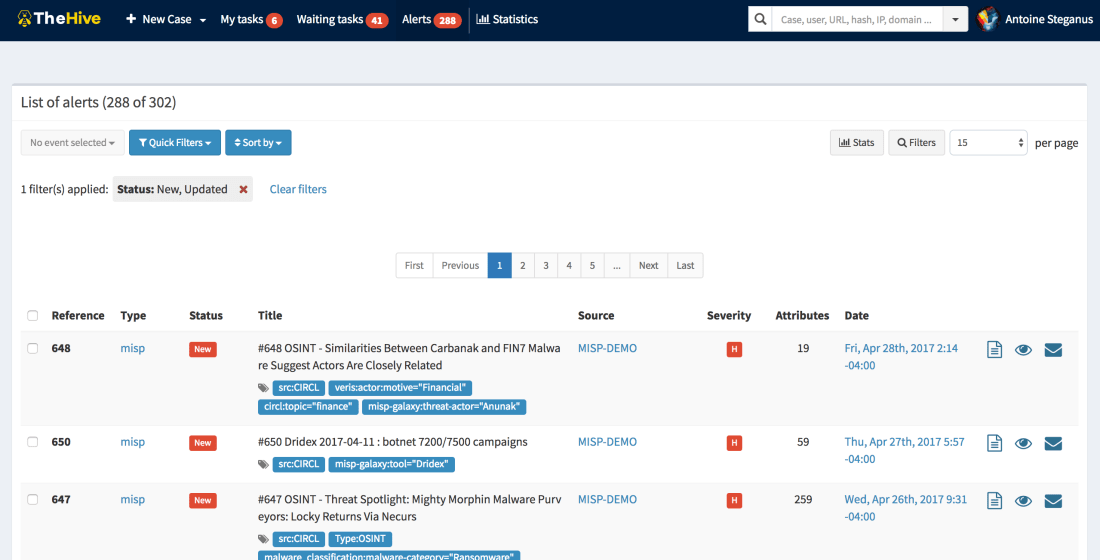
Any alert sent to TheHive will show up in its Alerts pane. In addition to the sources mentioned above, new or updated MISP events will show up as well in that area if you configured TheHive to connect to one or several MISP instances. If so, TheHive will poll those MISP instance(s) at every interval looking for new or updated events. If there are any, TheHive will generate an alert which will end up in the Alerts pane.

Screen Shot 2017-06-18 at 15.29.51.png
The Alerts Pane

Alerts can be ignored, mark as read, previewed and imported. When an alert is imported, it becomes a case that needs to be investigated.

Cases

workflow
The Workflow that is at the Heart of TheHive

A case can be generated from an alert or created from scratch. It is subdivided into tasks (think identification, containment, eradication, check proxy logs, and so on) and observables (IP addresses, hashes, email addresses, domain names, URLs…). When analysts are working on tasks, they add logs as they go. In TheHive’s terminology, logs are text entries which may contain attachments to help analysts record what they have been doing. Logs can be written using Markdown or a rich-text editor.

Case Templates

You don’t need to add the same tasks over and over when working on cases belonging to a given category (DDoS, Malspam, APT, …). You can create custom templates to which you add tasks as shown below. This is very useful when you are dealing with alerts so that when you import them, you can select which case template you’d like to apply and there you go!

Screen Shot 2017-06-16 at 10.26.22.png
A Sample Case Template
Observables

Observables can be tagged, flagged as IOCs, and analyzed. When the investigation is well in progress or completed, you may want to share the resulting IOCs or a subset of those with partners and peers. TheHive will support the ability to export that data to MISP in September 2017. Until then, you can still export your IOCs as text, CSV or as a MISP-compatible format that you can use to add them to your MISP instance using the freetext editor. TheHive can export IOCs/observables in protected (hxxps://www[.]somewhere[.]com/) or unprotected mode.

Every observable must have a TLP (Traffic Light Protocol) level. By default, any added observable is considered TLP:AMBER. Please note that the TLP is taken into account by some analyzers. Wait! Analyzers?

Cortex

Cortex is our standalone analysis engine and a perfect companion for TheHive and MISP. Analysts can use it to analyze observables using its Web UI, in which case they can be submitted only one at a time. The Web UI should really be limited to quick assessments of observables before creating a case in TheHive (or in an alternate SIRP). The power of Cortex really comes into play when you use its REST API. TheHive speaks natively to Cortex (as MISP does). Moreover, TheHive can leverage one or several Cortex servers.

Screen Shot 2017-06-18 at 15.57.27.png
Observable Page and List of Analyzers
Analyzers

As of this writing, Cortex has 23 analyzers which come in a total of 39 flavors and more will be available soon.

An analyzer can be written in any programming language supported by Linux though all of our current analyzers are written in Python. This is because we provide a Python library called Cortexutils which contains a set of utility classes that make it easier to write an analyzer in Python.

Flavors

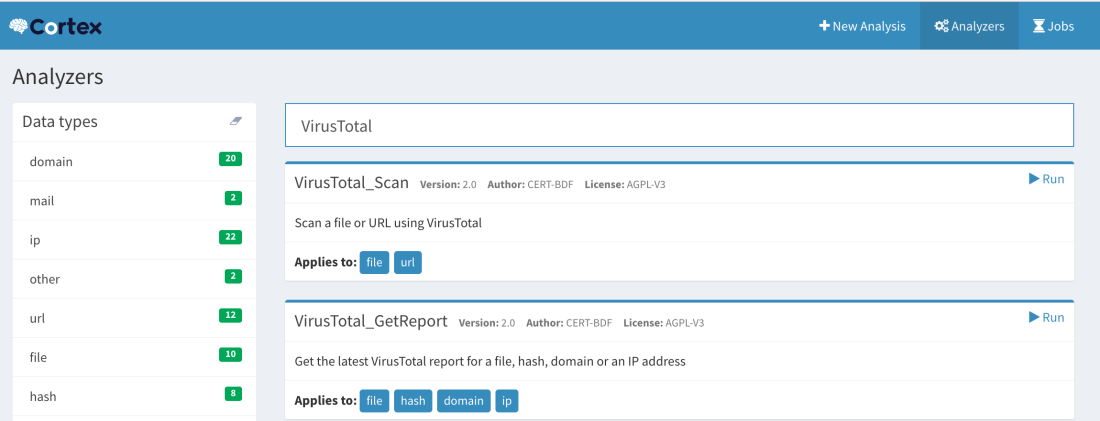
Analyzers such as VirusTotal, PassiveTotal or DomainTools can provide different analysis services. Let’s take VirusTotal as an example. You can scan a file or URL. That’s one flavor. You can also obtain the latest available report on VirusTotal.com for a file, hash, domain or IP address. That’s a second flavor. So the VirusTotal analyzer has two flavors.

Screen Shot 2017-06-18 at 16.26.41.png

How about PassiveTotal? It has 8 flavors: unique resolutions lookup, SSL certificate history lookup, malware lookup, passive DNS lookup, data enrichment lookup, SSL certificate details lookup, OSINT lookup and WHOIS data lookup.

The MISP Search Analyzer

At this point, we need to mention a special analyzer that may create some confusion if not understood correctly: the MISP Search analyzer. Thanks to it, Cortex has the ability to search observables within a MISP instance as represented by the arrow that goes from the Analyzers to MISP.

Screen_Shot_2017-06-19_at_08_03_54.png
Search for MISP Events Containing a Given Observable

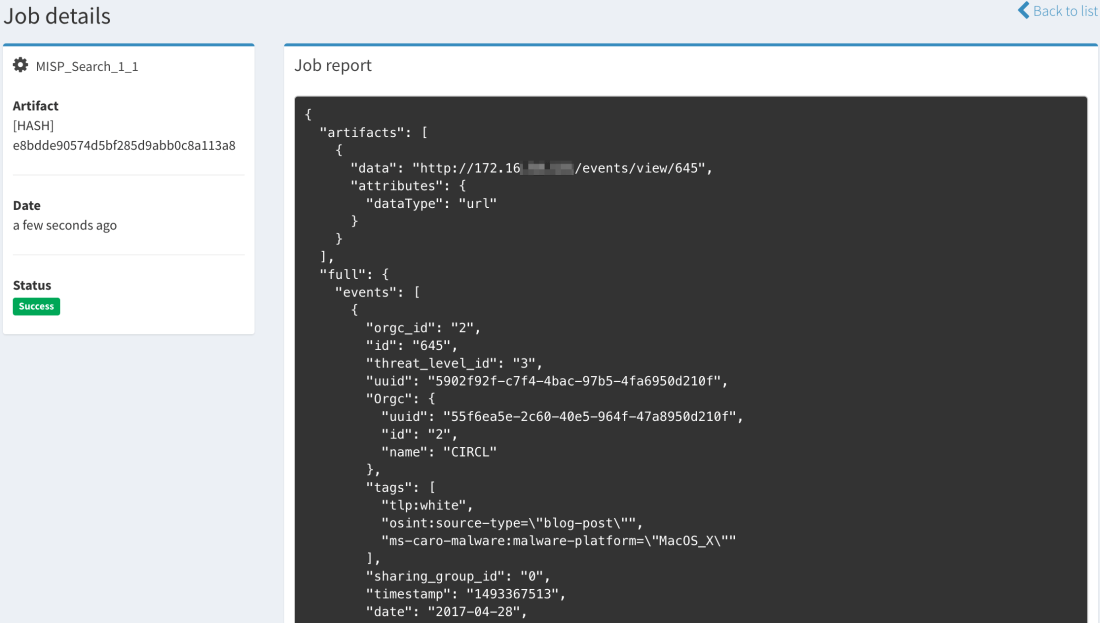
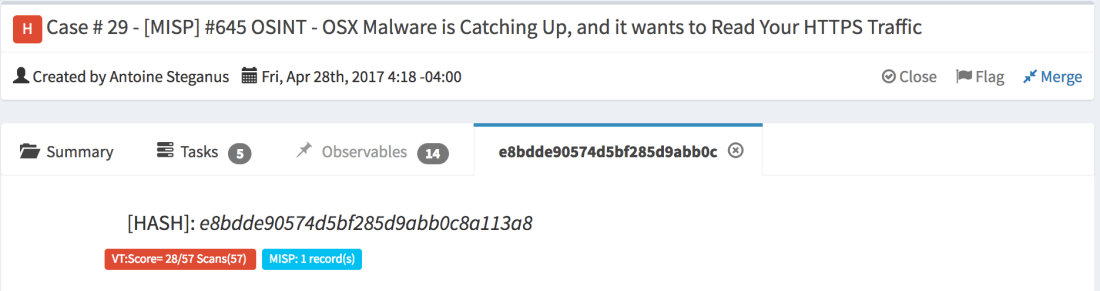
When an observable is found in an event, Cortex will return the number of records found (i.e. the number of events where the observable has been found) and a list of links to those events with additional data.

Screen_Shot_2017-06-19_at_08_13_16.png
Searching for a Hash Using the MISP Search Analyzer from the Cortex Web UI
Screen Shot 2017-06-19 at 08.17.04.png
The Same Search Conducted from TheHive: Long Report
Screen Shot 2017-06-19 at 08.18.58.png
Mini-Report

The current version of the MISP Search analyzer can only search within a single MISP instance but in the near future, it will be able to support multiple ones.

MISP Expansion Modules

Besides its own analyzers (which include MISP Search described above), Cortex can also invoke MISP expansion modules. These are normally used by MISP to enrich attributes within events but Cortex can also take advantage of them to analyze observables.

There is some overlap between the native Cortex analyzers and MISP expansion modules. When choosing between a native analyzer or an expansion module, we highly recommend you select the former. The expansion modules are deactivated in the default Cortex configuration.

Jobs

When you submit an observable for analysis, Cortex will create a job and, if successful, it will generate an analysis report in JSON format. TheHive has the ability to parse those results and present them in a human-friendly fashion thanks to report templates we offer for free. So when you’ll submit an observable to Cortex from TheHive, you’ll get back a short (or mini) report and a long one. The first can be thought of as a really tiny Exec Analyst Summary while the second provides more insight and details.

Calling Cortex from MISP

In addition to the expansion modules we have just mentioned, MISP 2.4.73 and up can enrich attributes using Cortex analyzers. The configuration is pretty straightforward. So if all you are concerned about is threat intelligence and sharing, you may augment your visibility into a given threat represented as a MISP event by leveraging all current 23 Cortex analyzers and any future ones.

Conclusion

TheHive, Cortex and MISP are three open source and free products that can highly aid you combat threats and keep the ‘monsters’ at bay.

TheHive, as a SIRP, allows you to investigate security incident swiftly in a collaborative manner. Several analysts can work simultaneously on tasks & cases . While cases can be created from scratch, TheHive can receive alerts from different sources thanks to alert feeders which consume security events generated by multiple sources and feed them into TheHive using TheHive4py Python library. TheHive can also sync to one or several MISP instances to receive new and updated events which will appear in the alert pane with all the other alerts generated by other sources. Analysts can then preview new alerts to decide whether they need to be acted upon. If so, they can transform them into investigation cases using templates.

To analyze the observables collected in the course of an investigation and/or imported from a MISP event, TheHive can rely on one or several Cortex analysis engines. Cortex is another standalone product that we have developed which sole purpose is to allow you to analyze observables at scale thanks to its large number of analyzers, MISP expansion modules and any analyzer you might have developed on the side. Cortex has a REST API that can be used to empower other security products such as  ‘analytics’ software, alternate SIRPs or MISP.

The highly popular threat sharing platform can indeed enrich attributes thanks to Cortex as it has a native integration with it. And in a few months, you will also be able to export cases from TheHive as MISP events that you can share with peers and partners.

If you do share, you do care about our collective mission to defend the  digital assets that are under our watch from harm. So let us fight together as one.


Cortex 1.1.2 Released

We are glad to announce a new version of your favorite observable analysis engine which corrects bugs introduced by version 1.1.1 and adds a few enhancements. As a reminder, TheHive, our Security Incident Response Platform, can interact with one or several Cortex instances. Moreover, starting from version 1.1.1, Cortex has a two-way integration with MISP.

We highly advise you to upgrade your Cortex in to instance to 1.1.2.

Screen Shot 2017-05-24 at 11.51.54.png
Cortex 1.1.2 – Job Report Example with CERT-SG’s Abuse Finder

Fixed Issues

  • #27: fixed the daunting error 500 that many users of  TheHive encountered when a job is submitted to Cortex.
  • #29: the MISP expansion modules are now disabled by default to avoid another error 500.
  • #31: the web interface was displaying SNAPSHOT (oops!) for the Cortex version.  It now displays the correct version.

Enhancements

  • #28: when you enable the MISP expansion modules, Cortex will not be slowed down and starts without delay.
  • #30: add a page loader mask similar to TheHive’s.

Download & Get Down to Work

To update your current Cortex installation, follow the instructions of the installation guide. Before doing so, you may want to save the job reports that were not executed via TheHive. Cortex 1 has no persistence and restarting the service will wipe out any existing reports.

Please note that you can install Cortex using an RPM or DEB package, deploy it using an Ansible script, use Docker, install it from a binary or build it from sources.

Support

Something does not work as expected? You have troubles installing or upgrading? No worries, please join our  user forum, contact us on Gitter, or send us an email at support@thehive-project.org. We are here to help.

VMRay, FireHOL, Joe Sandbox & Fortiguard Analyzers

We are pleased to announce the availability of 2 new Cortex analyzers and an update to 2 existing ones:

  • New: VMRay and FireHOL
  • Updated: Joe Sandbox and Fortiguard URL Category

We would like to thank Nils Kuhnert from CERT-BUND, CERT-BDF and Eric Capuano for their precious contributions.

To install the new analyzers, grab the Cortex-Analyzers repository and unpack its content (or git pull the master  branch) in your existing /path/to/cortex-analyzers. Then follow the Cortex analyzers guide.

To import the new report templates in your instance of TheHive:

  • download the updated package
  • log in TheHive using an administrator account
  • go to Admin > Report templates menu
  • click on Import templates button and select the downloaded package

VMRay

The VMRay analyzer has been submitted by Nils Kunhert from CERT-BUND. It lets you run a file in a local or remote (cloud) VMRay sandbox. The analyzer also lets you check existing analysis reports.

The analyzer accepts files and hashes as input. VMRay is a commercial service and you need an API key to run the analyzer. To make it work, install the requests Python library. It should already have been installed since it is used by other analyzers as well.

To use the analyzer, add the following section to the Cortex configuration file (application.conf):

VMRay {
 url = ""
 key = ""
 certpath = ""
 }

When called from TheHive, the following output is produced:

sc-short-vmray.png

sc-long-vmray.png
TheHive: VMRay Analyzer – Short and Long Report Samples

Important note: an analysis on VMRay, like on any other sandbox, can take a long time. That is why the analyzer tries to fetch the report until it is ready.

FireHOL

The FireHOL analyzer has been submitted by Nils Kuhnert from CERT-BUND. It lets you use the lists maintained by FireHOL project and check if an IP resides in one of them. FireHOL is an open source project. The analyzer reports the block lists in which an IP resides with the latest updated ones displayed first. To make it work, you’ll need to download the lists in a directory first (and it would be wise to do it on a regular fashion using a cron entry for example):

git clone https://github.com/firehol/blocklist-ipsets

The FireHOL analyzer depends on the following librairies:

ipaddress
pytz
dateutil
datetime

Add the following section to the Cortex configuration file (application.conf) to activate the analyzer:

FireHOLBlocklists {
 blocklistpath = ""
 ignoreolderthandays = <int>
 }

The ignoreolderthandays parameter lets you tell the analyzer to ignore matches found in lists that have not been refreshed in <int> days where <int> is an integer.

When called from TheHive, the following output is produced:

sc-short-fireHOL.png

sc-long-firehol.png

TheHive: FireHOL Analyzer – Short and Long Report Samples

Joe Sandbox

Thanks to CERT-BDF, the Joe Sandbox analyzer has been updated to support Joe Sandbox Cloud service beside the on-premises version (Ultimate). Like with other Joe Sandbox services, you need to add the following section to the Cortex configuration file (application.conf):

JoeSandbox {
 url = ""
 apikey = ""
 }

Fortiguard URL Category

Thanks to Eric Capuano, the Fortiguard URL Category analyzer is working again. Eric has modified it to handle the changes made by Fortiguard to their free online API.

Correction: May 23, 2017
An earlier version of this post used ignoredays instead of ignoreolderthandays for the FireHOL Blocklists analyzer. This parameter has also been described.

Joe Sandbox, MISP Search and Report Improvements

We are thrilled to announce that Cortex has two new analyzers: Joe Sandbox and MISP Search. Moreover, we have produced new analyzer report templates for TheHive and improved existing ones.

Joe Sandbox

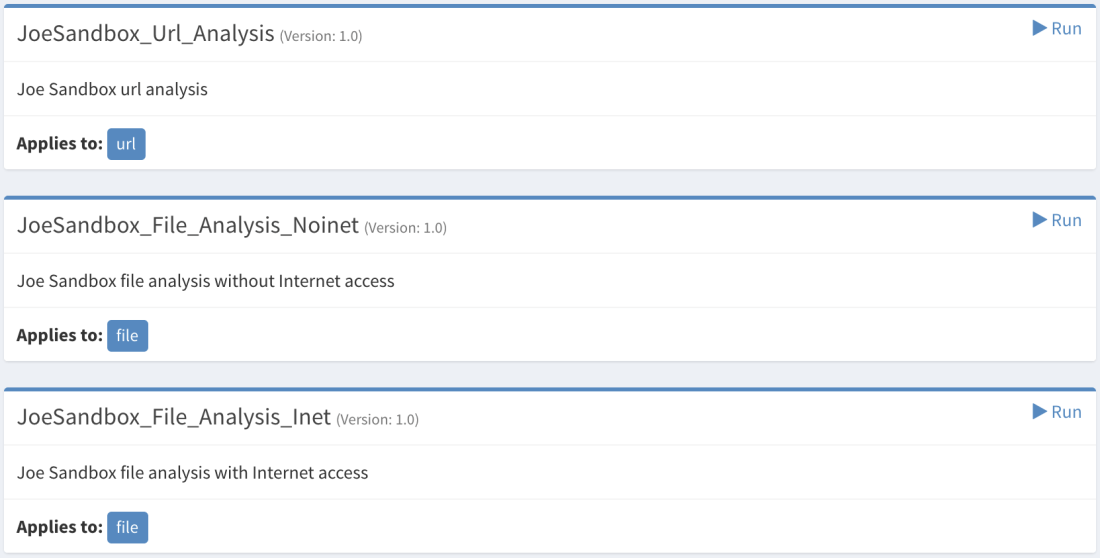
List JSB Cortex.png
Cortex: New Joe Sandbox Analyzer

Joe Sandbox, by Joe Security LLC, is a very powerful malware analysis platform that has been around for many years and comes in two flavors: cloud and on-premises. The Joe Sandbox Cortex analyzer has been tested using an on-prem Joe Sandbox Ultimate version and can process URLs and files. The analyzer can process files with or without Internet access.

To use the analyzer, you must provide the API key of your Joe Sandbox instance. You must log in to Joe Sandbox, click on your account name, then on Settings and on the API Key tab.

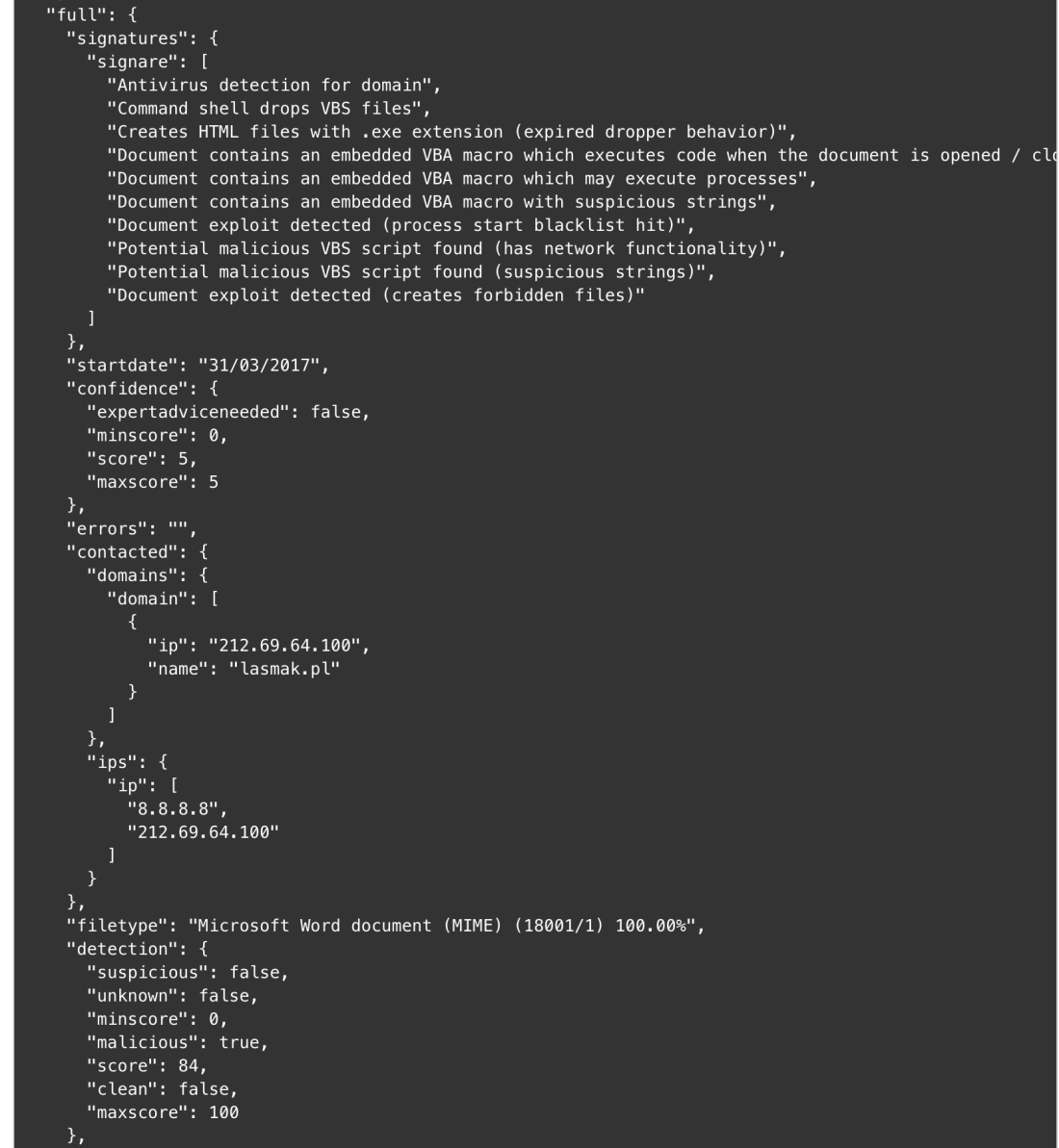
report JSB Cortex.png
Cortex: Joe Sandbox Output Example

We have produced a report template for the Joe Sandbox analyzer output resulting from file analysis. The URL analysis report template is not yet available but it should be in a few days.

JSB TH short report

JSB_THEHIVE.png
TheHive: Joe Sandbox Analyzer – Short and Long Report Samples

MISP Search

Screen Shot 2017-03-31 at 15.25.07.png
Cortex: New MISP Search Analyzer

It is no longer necessary to present MISP, the de facto standard of threat sharing. The new MISP Search analyzer will let you search events containing the observable you provide as an input. It applies to a lot of observable types as you can see in the screenshot above.

To use it, you’ll need to supply the API key available in the MISP UI interface.

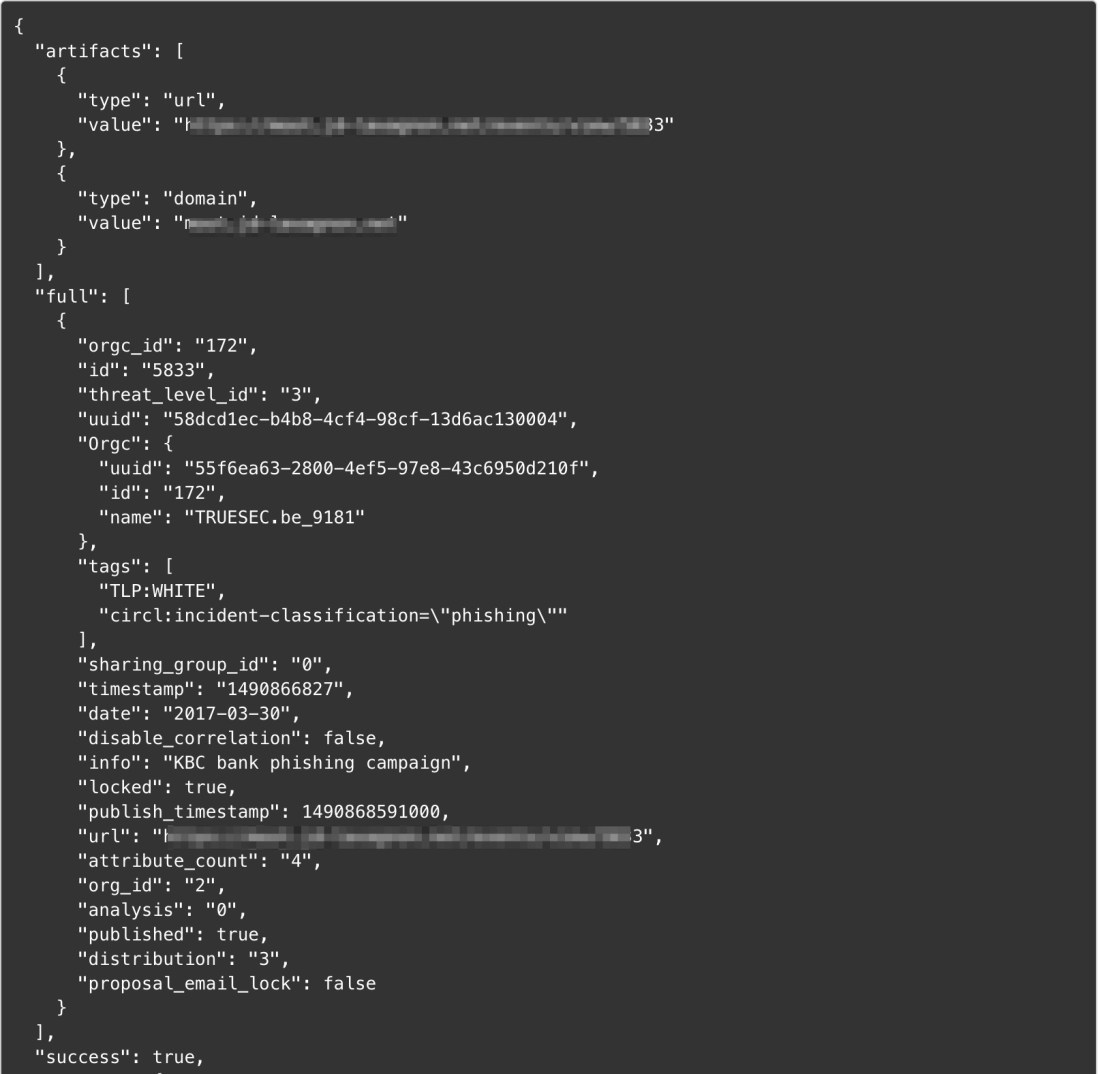
result_MISP_Cortex.jpg
Cortex: MISP Analyzer Output Sample

Nils Kuhnert created an alternate MISP Search analyzer which has the ability to query multiple MISP instances. We are currently reviewing his submission along with several other analyzers he contributed before improving the newly released MISP Search analyzer.

PassiveTotal Report Templates

PT Whois short report.pngPT UniqueRes TH short report.png

While we published the PassiveTotal analyzer weeks ago, TheHive didn’t have report templates for it at the time. We have now new, shiny short and long report templates for most of the services provided by the PT analyzer.

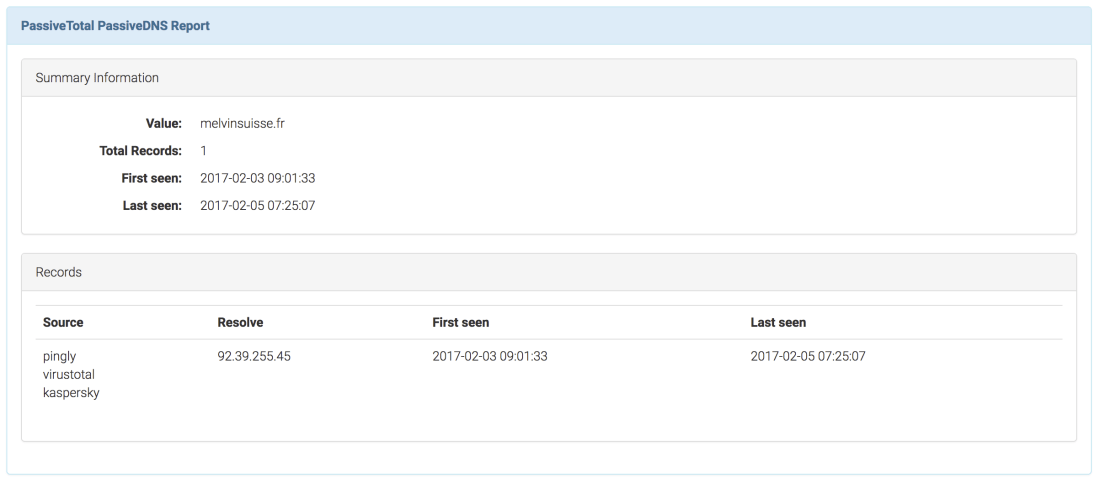
PT PDNS long report.png
TheHive: PassiveTotal PassiveDNS – Long Report Sample

DomainTools Whois Lookup Report Template

DT Whois TH short report.png

The short report templates of the DomainTools Whois Lookup analyzer has been improved. We now use a taxonomy to provide more context and differentiate between the DomainTools and PassiveTotal Whois results.

VirusTotal Get Report and VirusTotal Scan Report Templates

VT TH short report.png
VT and JSB TH short report.png

The short report templates for both services have also been improved to use a taxonomy to provide additional context and distinguish their results from the PassiveTotal Malware service.

Get the new analyzers

To install the new analyzers, grab the Cortex-Analyzers repository and unpack its content (or git pull the master  branch) in your existing /path/to/cortex-analyzers.

The Joe Sandbox analyzer does not need any additional Python library if you have already installed Cortex and the analyzers following the guide we provide.  To use it, edit your Cortex configuration file (/path/to/cortex/application.conf) and add the following lines in the analyzer section:

 JoeSandbox {
     apikey="..."
     url="..."
 }

By default, Joe Sandbox will time out the analysis after 30*60 seconds (30 minutes). Additionally, the analyzer will wait for the Joe Sandbox server to respond within 30 seconds. If no response is received within this period, it will time out. If you want to override these values, you’ll need to add the following lines in the analyzer section:

JoeSandbox {
     apikey="..."
     url="..."
     analysistimeout=<NEW VALUE> # optional
     networktimeout=<NEW VALUE> # optional
}

The MISP Search analyzer requires pymisp. Use the following command line to install the required library:

sudo pip install pymisp

Then edit your Cortex configuration file (/path/to/cortex/application.conf) and add the following lines in the analyzer section:

MISP {
     api_key="..."
     url="..."
}

Please note that you must restart Cortex to take the changes into account. The current version has no persistence so you’ll lose all your existing jobs.

You can find the full installation requirements for Cortex and Cortex-Analyzers on the Cortex wiki pages.

Use the New Report Templates

To import the new report templates in your instance of TheHive:

  • download the updated package
  • log in TheHive using an administrator account
  • go to Admin > Report templates menu
  • click on Import templates button and select the downloaded package

Running Into Trouble?

Shall you encounter any difficulty, please join our  user forum, contact us on Gitter, or send us an email at support@thehive-project.org. We will be more than happy to help you!